Why the AI Detection Arms Race Is Already Over
AI detection tools fail 94% of the time. Schools shifting from detection to assessment redesign report fewer integrity issues. What works.
December 16, 2025
Last semester, one of my best English teachers walked into my office holding a stack of flagged essays. “Three of my strongest writers,” she said. “Turnitin says they all cheated. I know they didn’t.”
She was right. They hadn’t.
That moment crystallized something I’d been avoiding: the detection approach wasn’t working. We were spending more time investigating flags than teaching writing. And the data backs this up.
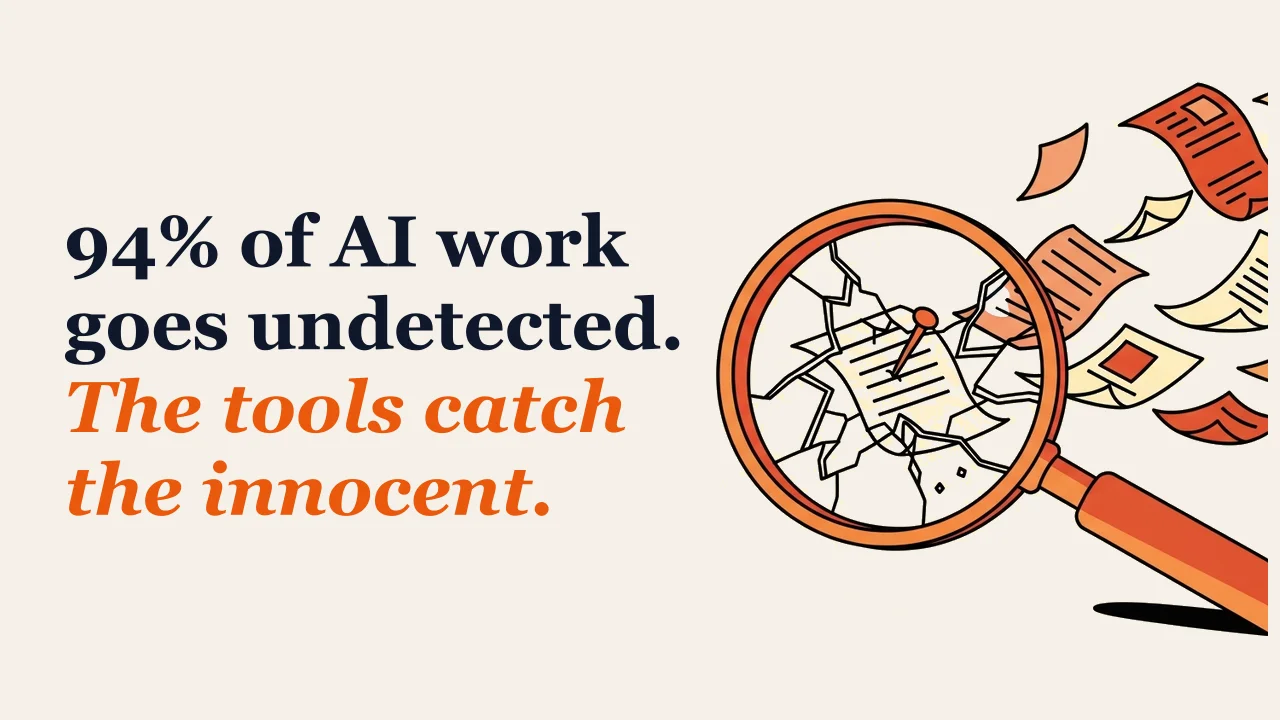
University of Reading researchers tested leading AI detection tools and found they correctly identified AI-generated content only 6% of the time. That means 94% of AI-written work goes undetected. Meanwhile, NPR’s investigation found that 73% of student-reported AI detection incidents involve disputed false positives. Students accused of cheating when they hadn’t.
The tools designed to catch cheaters are missing almost everyone while flagging the innocent. That’s not a solution. That’s theater.
of AI-written work is correctly identified by detection tools
Watch out
The real question
If your detection tool misses 94% of actual AI use while falsely accusing students who did their own work, what exactly is it protecting?
Why Detection Tools Fail
This isn’t a matter of needing better algorithms. The fundamental approach is broken for three documented reasons.
The Reliability Problem
Detection tools are statistically unreliable at a level that should disqualify them from any disciplinary process. Packback’s 2025 analysis surveyed faculty across institutions and found they rate AI-specific plagiarism policies as only 28% effective. OpenAI shut down its own AI classifier after acknowledging it couldn’t reliably distinguish human from AI writing.
The problem is fundamental: AI is trained on human writing. The better it gets, the more human it sounds. Detection is a losing game.
The Discrimination Problem
Detection tools don’t flag all students equally. Research from Stanford found that AI detectors are biased against non-native English speakers, flagging their writing as AI-generated at significantly higher rates. ESL students, students with certain learning differences, and students who write in more formal or structured styles all face elevated false positive rates.
NPR’s investigation documented students whose academic standing was damaged by false accusations, including cases where teachers flagged essays about personal experiences no AI could have written.
The Evasion Problem
Even if detection tools worked perfectly today, they’d be obsolete tomorrow. There are entire YouTube channels and Discord servers dedicated to teaching evasion techniques. Students share prompts that produce “undetectable” output. The detection-evasion arms race is unwinnable. Every hour spent on it is an hour not spent on instruction.
Princeton’s McGraw Center for Teaching and Learning advises against relying solely on AI detectors. MIT’s guidelines emphasize assessment design over detection. The institutions that understand AI best have already moved on.
Before
Spending $15,000/year on detection software that catches 6% of AI use
After
Investing that budget in teacher training for assessment redesign
The ROI shift schools are making
Why Students Reach for AI in the First Place
Understanding motivation is essential. If you only focus on catching the behavior without addressing the cause, you’re treating symptoms while the disease spreads.
RAND’s 2025 study found that 88% of students now use generative AI specifically for assessments, up from 53% just one year earlier. That’s not a few bad actors. That’s a systemic response to something in the system.
Students using generative AI for assessments
Research points to four primary drivers:
Time pressure. Overloaded students take shortcuts on lower-priority work. The design response: assignments with built-in process time and realistic workload calibration.
Disconnection. “This assignment is pointless anyway.” The design response: tasks connected to student interests, local context, or genuine inquiry.
Unclear expectations. “I didn’t know that wasn’t allowed.” The design response: explicit AI use guidelines per assignment, not blanket bans.
Learning at speed. Students use AI to teach themselves new concepts quickly, not to cheat, but to keep up. The design response: explicit instruction on synthesis, analysis, and making ideas your own.
Here’s what I’ve observed: many students aren’t plagiarizing on purpose. They’re using AI to teach themselves at speed, especially for science and coding projects involving new technology. They hit a concept they don’t understand, ask AI to explain it, and incorporate that explanation into their work. The problem isn’t dishonesty. It’s that they don’t yet have the tools to analyze information and break it down into their own thoughts.
This isn’t new. Students have always struggled with synthesis: copying from Wikipedia, paraphrasing textbooks too closely, stitching together sources without adding original thinking. AI just made it faster and more seamless. The solution isn’t detection. It’s teaching the skills we should have been teaching all along.
“Don’t use AI” is not a policy. It’s a prohibition that invites workarounds. Students need clarity about what’s acceptable, not rules that pretend AI doesn’t exist.
What Actually Works: Assessment Redesign
The schools seeing real results have stopped asking “how do we catch AI use?” and started asking “how do we design assessments where authentic engagement is the path of least resistance?”
This approach is called assessment redesign, and it’s built on a simple insight: if students can complete an assignment entirely with AI and still get a good grade, the assignment is measuring the wrong thing.
Vera Cubero, who led the development of North Carolina’s AI guidelines, widely recognized as among the best in the nation, frames generative AI as an “arrival technology.” Unlike “adoption technologies” like the internet, which schools could choose to implement gradually, AI arrived in classrooms whether schools adopted it or not. As Cubero wrote for the National Association of State Boards of Education: “It took nearly three decades for education institutions to adapt and fully incorporate the internet into their academic integrity policies… In contrast, generative AI is an ‘arrival technology,’ which does not require adoption.”
The implication is clear: you can’t block your way out of this. You have to design your way through it.
The Core Principles
Make AI assistance visible, not hidden. Students write a first draft independently, then use AI to critique their work, and must explain what feedback they accepted or rejected and why. The thinking becomes the product.
Require process, not just product. Drafts, revision histories, peer feedback, and in-class components make the learning journey visible. When you can see how a student arrived at their final work, AI use becomes less fraught.
Connect to context AI can’t access. Assignments grounded in local community, personal experience, current events after AI’s training cutoff, or original primary research can’t be completed by prompting ChatGPT.
Make AI use explicit and bounded. Instead of “don’t use AI,” specify: “You may use AI for brainstorming but not drafting. Document any AI suggestions you incorporated and explain why.”
AI for Education’s framework provides practical guidance for implementing these principles, including the CRAFT model for responsible AI use that I’ve adapted in my own teacher training.
A Concrete Example
Before
Write a 5-paragraph essay analyzing the themes of The Great Gatsby
After
Interview a family member about their version of 'the American Dream.' Record key quotes. Compare their perspective to Gatsby's using at least 3 specific scenes from the novel. You may use AI to help identify themes in your interview transcript, but the analysis connecting their story to Fitzgerald's must be your own words. Submit: transcript, AI interaction log, and final essay.
The second assignment can’t be completed by AI alone. It requires original research (the interview), personal connection (the family member’s story), and documented process (the transcript and AI log). A student could still misuse AI, but doing the actual work is now easier than faking it.
The Shift in Practice
MagicSchool’s approach represents where leading EdTech is heading: AI as a formative feedback tool, not a threat to police. Students use AI to get feedback aligned to the teacher’s rubric, asking “Why is this a weak thesis?” instead of “Write this for me.”
The practical implementation looks like this:
- Students draft independently first (timed in-class writing establishes baseline)
- They use AI for formative feedback on their draft
- They revise based on that feedback, documenting what they changed and why
- They submit the final draft with their revision notes and AI interaction log
The technology didn’t change. The adult framing did.
Key move
The key insight
Detection asks: “Did you cheat?” Redesign asks: “Show me your thinking.” One creates an adversarial relationship. The other creates a learning conversation.
What Happens If You Don’t Make This Shift
I want to be direct about the stakes.
You’ll keep losing. Detection tools will never catch up to AI capabilities. You’re investing in a solution that gets less effective every month while the problem grows.
You’ll damage relationships. Every false accusation erodes trust that took months to build. Students who feel surveilled and suspected don’t engage authentically. They learn to game the system.
You’ll miss the opportunity. While you’re playing defense, other schools are teaching students to use AI as a thinking partner. Their students will graduate with skills yours won’t have.
You’ll face liability. Disciplining students based on tools with 94% miss rates and documented bias against ESL students is legally precarious. The Center for Democracy and Technology warns that over-reliance on detection creates significant due process concerns.
Where to Start
This week: Pick one assignment you suspect students are already using AI on. Don’t redesign it yet. Just look at it honestly. Could a student complete this entirely with ChatGPT and get a B? If yes, that’s your pilot.
This month: Redesign that one assignment using the three moves: add a process component, make AI use explicit, and connect to something AI can’t access. Run it with one class and compare results.
This quarter: Bring your pilot data to your department or leadership team. Show what happened when you stopped trying to catch AI and started designing around it.
This semester: Develop a rubric for “AI-resistant” assignment design and apply it to your highest-stakes assessments. Create shared expectations so teachers aren’t reinventing the wheel.
The goal isn’t making cheating impossible. The goal is making learning visible and making authentic engagement more rewarding than shortcuts.
→ This post is part of The School Leader’s Guide to AI in 2026, a comprehensive resource for navigating AI in education.
→ For a practical policy framework that includes assessment redesign, see Building an AI Policy That Actually Works.
Frequently Asked Questions
Do AI detection tools ever work?
No detection tool is reliable enough to base disciplinary action on. University of Reading research found that 94% of AI-generated work goes undetected, while NPR reports that 73% of flagged cases involve disputed false positives. The tools are better at catching innocent students than actual misuse.
Won’t students just cheat more if we stop detecting?
Evidence suggests the opposite. Schools that shifted to assessment redesign (where process is visible and AI use is explicit rather than hidden) report fewer integrity issues, not more. When doing the actual work becomes easier than faking it, most students do the actual work.
How do I convince my administration to stop using detection tools?
Lead with the data: 6% detection rate, 73% false positive dispute rate, documented bias against ESL students, and the liability of disciplining students based on unreliable algorithms. Point to states like North Carolina, whose AI guidelines explicitly recommend against relying on detection. Then propose a pilot: redesign one high-AI-use assignment using the principles above and compare results.
What about high-stakes assessments like finals?
Include in-class components for high-stakes work. A timed writing sample establishes what students can produce independently, creating a baseline for comparison. When students know their in-class voice is documented, take-home components become less fraught.
Isn’t this just giving up on academic integrity?
It’s the opposite. Detection-based integrity says “don’t get caught.” Redesign-based integrity says “show your thinking.” The second approach actually teaches students why authentic work matters and gives them the skills to produce it even when AI is available.
References
- We pitted ChatGPT against tools for detecting AI-written text, and the results are troubling - The Conversation / University of Reading
- AI detection tools are unreliable in schools - NPR
- Moving Beyond Plagiarism and AI Detection: Academic Integrity in 2025 - Packback
- OpenAI discontinues its AI writing detector due to low accuracy - Ars Technica
- AI Detectors Biased Against Non-Native English Writers - Stanford HAI
- AI Use in Schools Is Quickly Increasing - RAND Corporation
- The Shortcomings of Generative AI Detection - Center for Democracy and Technology
- Generative AI and Your Course - MIT Teaching + Learning Lab
- Opportunities and Challenges: Insights from North Carolina’s AI Guidelines - Vera Cubero / NASBE
- How to Use AI Responsibly Every Time (CRAFT Framework) - AI for Education

Want help building systems like this?
We help school leaders automate the chaos and get their time back.