What Parents Are Asking About AI—And How to Answer
Parents ask 5 core questions about AI in schools, masking fears about fairness and being out of the loop. What they're really asking—and how to respond.
January 10, 2026
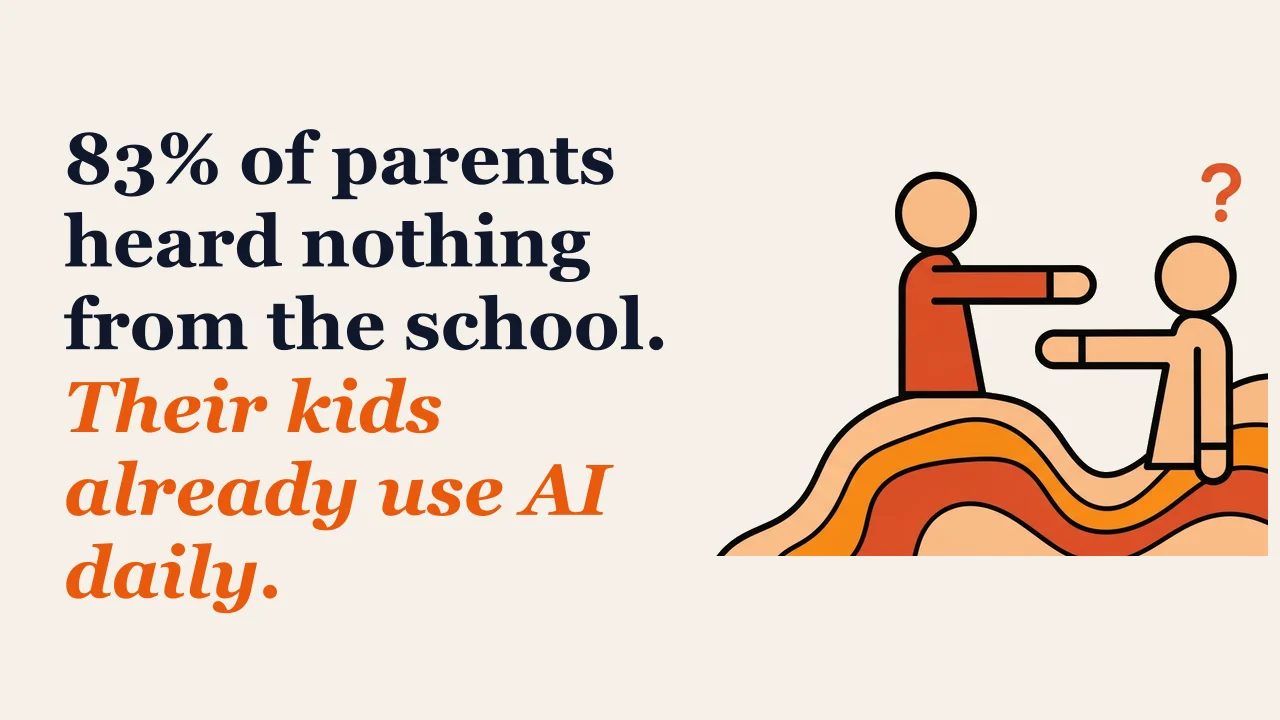
83% of parents say their child’s school has never communicated with them about generative AI. Meanwhile, 70% of teens have already used AI tools. The gap between what students are doing and what parents know creates anxiety, mistrust, and conflict. Proactive communication isn’t just good practice—it’s the difference between partnership and opposition.
The communication gap is staggering. According to Common Sense Media’s 2024 research, 83% of parents report that schools have never communicated with families about generative AI. At the same time, seven in ten teens have used at least one type of AI tool, and about six in ten say their school either has no rules for AI use or they’re not sure if rules exist.
Parents are asking questions. The question is whether you’re answering them—or letting silence fill the void.
What Five Questions Are Parents Really Asking?
When parents raise concerns about AI, they’re circling around five core questions—even if they don’t phrase them this directly:
Key move
Listen for the fear
Behind every question is usually a fear. Identify the fear and you can address what the parent actually needs to hear. “What’s your AI policy?” might really mean “I’m afraid my child is cheating and I don’t know what to do about it.”
What Fears Drive Parent Questions About AI?
Understanding parent fears helps you respond more effectively. A Samsung/Morning Consult survey found that while 88% of parents believe AI knowledge will be crucial for their children’s future, they expressed significant concerns: 56% worry about lack of human interaction, 48% fear negative impacts on critical thinking skills, and 48% worry about students using AI to cheat.
Fear of unfairness. Their child follows the rules while others cheat. The honest kid gets lower grades. The system rewards deception. This fear is well-founded—Learner.com’s survey found that 68% of parents believe using AI to cheat or gain unfair advantage is at least “somewhat common.”
Fear of skill gaps. Their child uses AI as a crutch and doesn’t develop real capabilities. They graduate unable to write, think, or problem-solve without AI assistance. This concern is why 84% of parents in the Samsung survey said it’s important to prioritize teaching AI ethics and responsible use alongside technical skills.
Fear of being out of the loop. Everyone else knows what’s happening except them. Their child is using tools they don’t understand. They can’t help or monitor effectively. The Center on Reinventing Public Education found a striking disconnect: only 16-20% of parents believe their children use AI for education—far lower than actual usage rates. And just 14% of parents report having discussed appropriate AI uses with their children.
Fear of schools being behind. The world is changing fast. Schools are slow. Their child is being prepared for a world that no longer exists. This anxiety intensifies when 81% of parents either don’t believe or aren’t sure AI is even part of their children’s curriculum, according to the Samsung survey.
At my school, I’ve noticed these fears surface most often around assessment time. Parents ask pointed questions about how we know their child’s work is authentic—not because they suspect their own child, but because they worry the playing field isn’t level. The most productive conversations happen when I acknowledge their concern is valid before explaining our approach.
How Should You Respond to Each Question?
On rules: “We expect students to be transparent about AI use, to use it purposefully rather than as a substitute for thinking, and to develop foundational skills before leveraging AI to enhance them. Specific expectations vary by assignment and are communicated by teachers. If you’re ever unsure what’s allowed, ask—we’d rather have the conversation than have uncertainty.”
On integrity: “We’ve shifted from trying to detect AI use to designing assignments where authentic engagement is visible. We require process documentation, incorporate in-class components, and design tasks that connect to personal and local context that AI can’t access. This doesn’t catch every violation, but it makes cheating harder and learning more visible.”
On learning: “We share your concern about students developing real skills. That’s why we design assignments that require students to demonstrate understanding, not just produce outputs. We look for thinking, not just answers. If you’re concerned about your specific child, let’s look together at what they can do independently.”
On AI education: “We’re teaching students to use AI as a tool—how to prompt effectively, how to evaluate outputs, how to verify information, and how to know when AI is and isn’t appropriate. These skills matter for their future, and hiding from AI won’t serve them well.”
On whether to worry: “AI is changing how we work and learn. That’s real. But the fundamentals haven’t changed: reading carefully, thinking critically, communicating clearly, and collaborating effectively still matter—maybe more than ever. We’re adapting our approach while keeping focus on what matters most.”
The language that resonates most with our parent community emphasizes partnership. Phrases like “we share your concern” and “let’s look together” signal that we’re on the same side. I’ve found parents respond much better to “we’re learning alongside your child” than to claims of having everything figured out.
Why Does Proactive Communication Beat Reactive Damage Control?
When schools don’t communicate about AI, parents fill the vacuum with anxiety. The Learner.com survey found that 50% of parents are unaware of their school’s AI policy—and 97% express at least one concern about AI integration in education, with an average of three concerns per parent. Assumptions grow. Trust erodes. A few minutes of proactive communication saves hours of damage control.
At the start of the year: Share your AI philosophy and policy. Explain your reasoning. Invite questions. A single proactive communication prevents dozens of reactive ones.
Regularly through the year: Brief updates in newsletters. “Here’s what we’re learning about AI in education.” “Here’s how we’re adapting.” Transparency builds trust.
When something goes wrong: Don’t hide it. Parents respect honesty more than perfection. “We had an incident, here’s how we handled it, here’s what we learned” builds credibility.
Through parent education opportunities: EdWeek reports that Common Sense Media has released an AI literacy toolkit specifically for parent education, including slide presentations schools can use for AI information sessions and conversation starters to help families discuss AI at home. “As AI becomes increasingly sophisticated, we’re trying to develop more resources for families to have that human connection,” said Yvette Renteria, Common Sense Media’s chief program officer. Parents who understand the landscape become partners.
Watch out
The trust cost of silence
Schools that communicate proactively about AI build parent partnerships. Schools that wait for problems create anxious critics. The investment in communication pays off.
What Can Parents Do at Home?
End conversations with parents by empowering them with concrete actions. The Common Sense Media parent guide emphasizes that “when families discuss generative AI, kids feel more confident in using it safely and responsibly.”
Ask about AI use openly. “Did you use any AI tools for this? How?” makes AI visible rather than hidden. Curiosity works better than accusation.
Discuss assignments together. “What are you supposed to be learning here? How would AI help or hurt that?” builds metacognition about purposeful use.
Model thoughtful AI use. Use AI tools yourself and talk about it. When you verify an AI response or choose not to use AI for something, explain why. Research shows that 85% of parents are at least somewhat interested in learning more about AI to better support their child’s learning and development.
Stay curious, not panicked. AI isn’t inherently good or bad. The question is how it’s used. Approach it as a learning journey for the family.
Frequently Asked Questions
What if parents want to ban AI completely at home?
Acknowledge their concern, but note that complete bans are difficult to enforce and may leave students unprepared. Suggest focusing on “AI after the struggle”—students attempt work independently first, then can use AI to check or improve, with open conversation about what they learned.
How do we handle parents who think we’re not doing enough about AI cheating?
Share your assessment redesign approach with specific examples. Explain why detection-focused approaches have documented limitations—research shows that AI detection tools have high error rates and students can easily circumvent them. Offer to discuss their specific concerns about their child.
What if parents know more about AI than our teachers do?
That’s often true—and that’s okay. Invite their expertise. Ask what they’re seeing at home. Position the school as learning alongside families, not claiming to have all answers. EdWeek’s reporting on schools successfully engaging parents about AI emphasizes giving parents a primer on AI use in education while acknowledging its evolving nature.
Should we offer parent AI workshops?
Yes. Sessions covering “What AI Tools Your Kids Are Using” and “Having AI Conversations at Home” are consistently well-received. Parents who understand the landscape become partners rather than critics. Common Sense Media’s toolkit provides ready-to-use resources for these sessions.
How do we communicate about AI incidents without violating privacy?
Focus on what the school learned and how you’re responding, not on specific students. “We’ve seen situations where…” followed by “Here’s how we’re addressing this going forward” provides transparency without exposing individuals.
References
- The Dawn of the AI Era: Teens, Parents, and Adoption of Generative AI - Common Sense Media (September 2024)
- What Do Parents Know about Generative AI in Schools? - Center on Reinventing Public Education (November 2025)
- AI Education Survey: What Parents Really Think - Learner.com (May 2025)
- Most Parents Know AI Will Be Crucial to Their Children’s Future - eSchool News / Samsung Morning Consult (October 2024)
- Parents Need AI Literacy Lessons, Too - Education Week (November 2025)
- How These Schools Are Getting Parents on Board With AI - Education Week (February 2025)
- Guide to ChatGPT for Parents and Caregivers - Common Sense Media
- Schools’ Embrace of AI Connected to Increased Risks to Students - Center for Democracy & Technology (October 2025)
- Parents’ Ultimate Guide to Generative AI - Common Sense Media

Want help building systems like this?
We help school leaders automate the chaos and get their time back.