Stop Scheduling Meetings to Decide What to Meet About
Half your calendar is pre-meetings for meetings. The problem isn't time management - it's decision architecture.
November 12, 2025
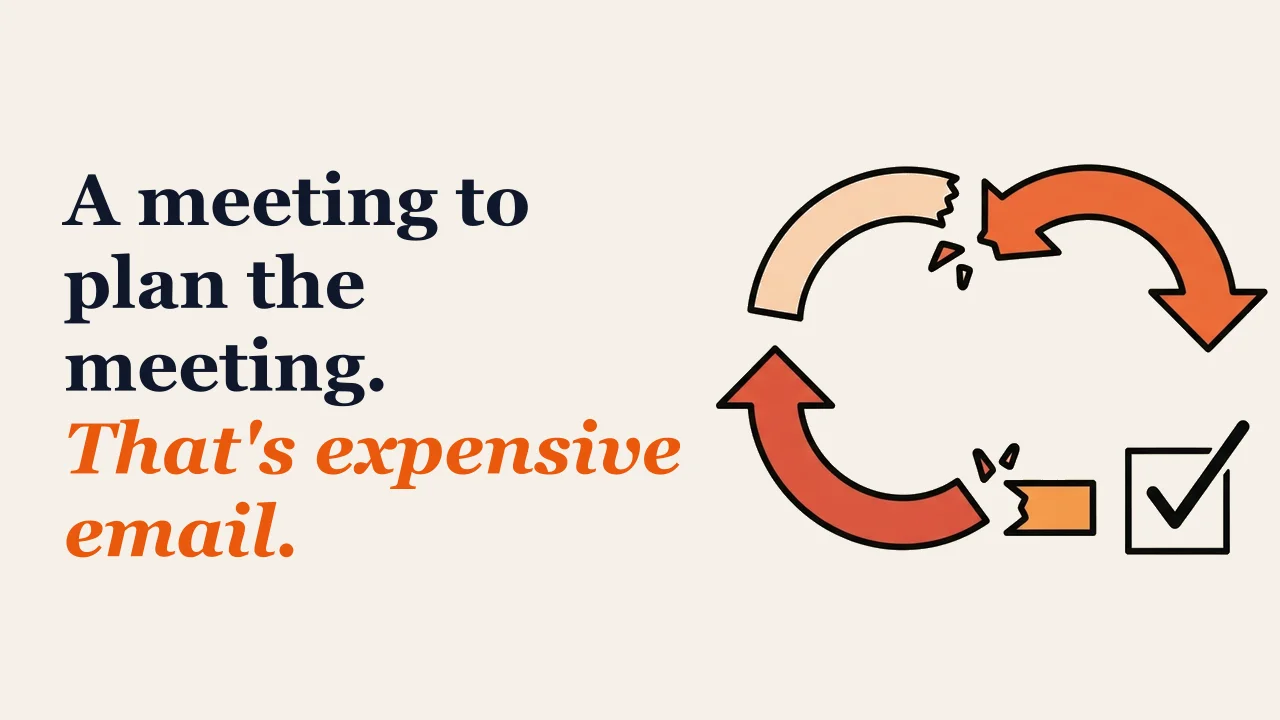
The Meeting About the Meeting
The pattern: Someone sends a meeting invite titled “Discuss curriculum changes.” You attend. Forty-five minutes later, the only decision made is that you need another meeting to actually discuss the curriculum changes - once you’ve gathered more information.
That first meeting wasn’t a meeting. It was expensive email.
The meta-problem: Schools and organizations don’t have too many meetings. They have too many meetings that don’t make decisions. And those create more meetings.
Why This Keeps Happening
The culprits:
1. Unclear meeting purpose
“Discuss X” is not a purpose. A purpose is: “Decide between option A and B.” Or: “Identify what information we need to decide between A and B.”
If your meeting invite doesn’t include the word “decide,” “finalize,” or “commit” - it might not need to be synchronous.
2. Missing pre-work
Meetings should be where thinking converges, not where it starts. When people show up without shared context, you spend the first 30 minutes getting everyone to the same starting line.
3. The wrong people in the room
Decision meetings need decision-makers. Information-gathering meetings need informers. Most meetings mush these together and nobody knows what role they’re playing.
Watch out
The expensive question
At a school, a one-hour meeting with 6 people costs roughly $300-500 in salary time. How many of those hours are generating $300 worth of decisions?
The Async Decision Template
Before scheduling a meeting, try this:
## Decision Needed
[One sentence: what are we deciding?]

## Background
[2-3 sentences max - link to documents for more]

## Options
Option A: [description]
- Pro:
- Con:

Option B: [description]
- Pro:
- Con:

## My Recommendation
[Which option and why]

## What I Need From You
- [ ] Agree and we proceed
- [ ] Disagree and suggest alternative
- [ ] Need clarification on [specific question]

## Timeline
Decision needed by: [date]
If no response by [date], I'll proceed with my recommendation.
What this does:
- Forces clarity about what’s actually being decided
- Gives people time to think before reacting
- Creates a paper trail of reasoning
- Sets a clear deadline
- Eliminates the meeting if everyone agrees
How often this works: About 60% of “discussions” can be resolved asynchronously once you frame them properly.
When You Actually Need to Meet
Legitimate meeting purposes:
- Conflict resolution - When two people have opposing views and need to hash it out in real-time
- Relationship building - New team member, new stakeholder, repair needed
- Complex coordination - Multiple dependencies that need simultaneous alignment
- Creative generativity - Actual brainstorming (rare)
- Sensitive communication - Delivering difficult news
Notice what’s NOT on this list:
- Status updates (use a shared document)
- Information sharing (use Loom or email)
- “Getting everyone on the same page” (that’s what async documentation is for)
The Meeting Audit
Pull up your calendar from last week. For each meeting:
- Was there a clear decision to be made?
- Was that decision actually made?
- Could the outcome have been achieved asynchronously?
Before
8 meetings this week, 2 decisions made
After
3 meetings this week, 3 decisions made
Fewer meetings, each with a clear purpose
The uncomfortable truth: Most recurring meetings exist because they were set up once and nobody has the courage to question them. “We’ve always had a Monday leadership team meeting” isn’t a reason.
The Pre-Read Protocol
For meetings that genuinely need to happen:
48 hours before the meeting:
- Circulate all relevant context documents
- Share the decision template above
- Ask participants to come with their position, not their questions
At the meeting:
- Skip the summary (everyone read the pre-read, right?)
- Go straight to positions and disagreements
- Make the decision
- Document it before leaving
The rule: If the pre-work isn’t done, cancel the meeting. Don’t reward people for not preparing by summarizing it for them.
Key move
The 'No Agenda, No Attend' Policy
Some teams adopt a strict policy: if a meeting invite doesn’t include a clear agenda with decision points, recipients are free to decline. It sounds harsh until you realize how much time it saves.
The Standing Meeting Problem
The most dangerous meetings are recurring ones.
They perpetuate regardless of whether there’s anything to discuss. People show up, someone fills the time, an hour disappears.
Fix options:
-
Make them opt-in: Post an agenda 24 hours ahead. If there’s nothing substantive, cancel.
-
Shorten them: Try 25 minutes instead of 60. See if the same work gets done.
-
Change the frequency: Weekly becomes biweekly. Most things don’t change that fast.
-
Kill them entirely: Replace with async updates and schedule ad-hoc when truly needed.
The Real Issue
Meetings are a symptom of a bigger problem →
→ The Difference Between Running a School and Being Run By OneToo many meetings usually indicate:
- Unclear decision rights (people don’t know who can decide what)
- Low trust (need to “be seen” participating)
- Avoidance (meetings feel productive without requiring actual output)
Fixing your meeting culture requires addressing these root causes. The templates and tactics help, but they’re treating symptoms if you don’t also clarify who decides what and create safety for asynchronous work.
Start Here
This week:
- Pick one recurring meeting
- Send the async decision template instead
- See if the meeting becomes unnecessary
saved by automating pre-meetings and unfocused discussions
That's roughly 208 hours per year back in your life.
Every meeting you eliminate creates space for something that actually requires your presence.

Want help building systems like this?
We help school leaders automate the chaos and get their time back.