68% of Teachers Have Zero AI Training. What That Means for Your School.
68% of teachers have zero AI training while 92% of students use AI tools. Traditional PD fails—here's what effective training looks like.
December 24, 2025
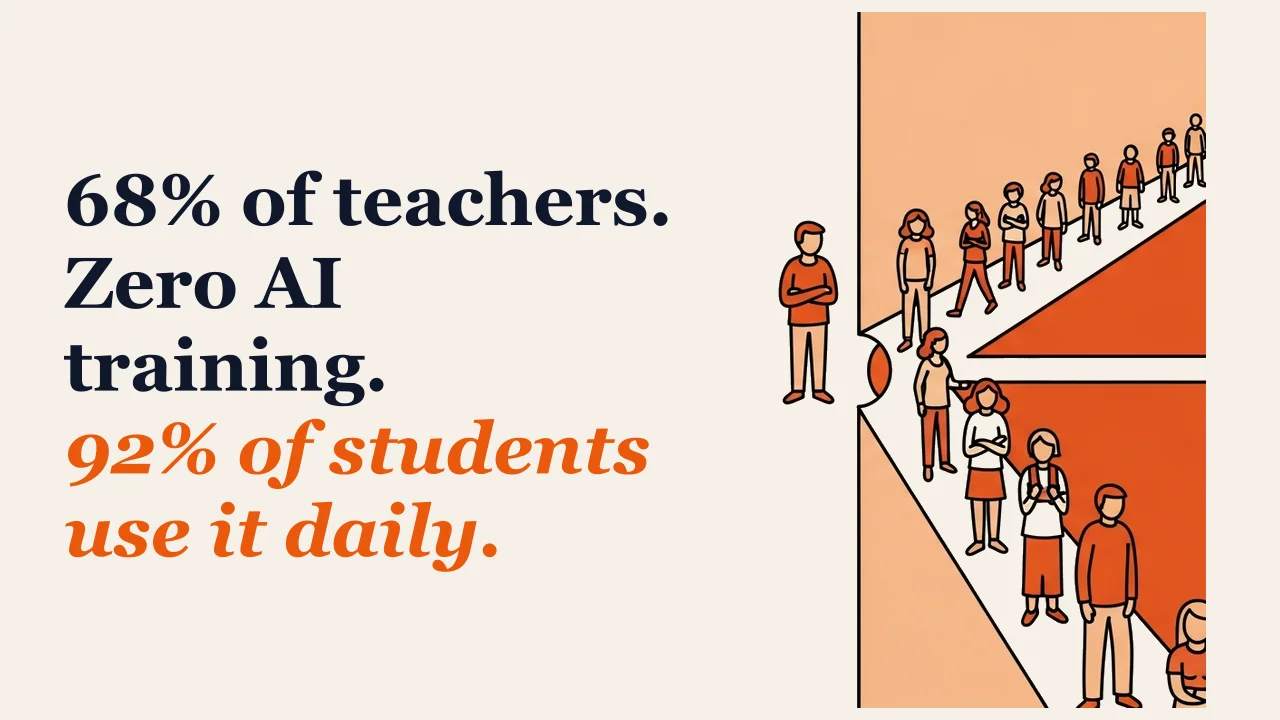
The DemandSage 2026 analysis and Gallup-Walton Family Foundation survey paint a stark picture: students are racing ahead while teachers are left without maps. The result is chaos: inconsistent policies, accidental privacy violations, and teachers making high-stakes decisions without guidance.
The solution is not a one-day workshop. According to the Gallup survey of over 2,200 teachers, educators using AI weekly save 5.9 hours per week, but only if they are trained in frameworks, not just tools.
When ChatGPT launched, the reaction at my school was typical: confusion from teachers, curiosity from students, and no clear guidance from anyone. Most of our teachers are non-technical and already stretched thin. They did not have time to learn new technology on top of everything else. My first priority was learning the tools myself so I could support my team with practical guidance, focusing on quick wins that would reduce their administrative overhead while showing them ways to actually improve their teaching.
What Happens When Teachers Get No AI Training?
Teachers are making it up as they go with predictable results:
- Some ban AI entirely and struggle to enforce it
- Some ignore it and get blindsided when problems emerge
- Some embrace it enthusiastically and inadvertently violate data privacy policies
The Discovery Education 2026 Trends Report documents a gap between leadership optimizm and teacher reality. While district leaders see AI as an opportunity, classroom teachers managing distraction, plagiarism, and unclear policies daily approach it with more caution.
RAND’s September 2025 study surveyed over 16,000 students, parents, teachers, and administrators. The finding that should alarm every school leader: only 45% of principals report having school or district policies on AI use, and over 80% of students said teachers did not explicitly teach them how to use AI for schoolwork.
Watch out
The confidence gap
Teachers who do not feel confident with AI cannot teach students to use it responsibly. They cannot make informed tool decisions. They cannot have substantive conversations with parents. No training creates a cascade of problems.
Why Does Traditional PD Fail for AI?
Most professional development treats AI like any other tool: a one-day workshop, a slide deck, a list of approved applications. This approach fails because AI operates differently than previous edtech.
Shift 1: From Annual Workshops to Ongoing Communities. AI changes faster than training cycles. The tool you demo in August may be obsolete by October. Teachers need continuous learning structures, not annual events.
Shift 2: From Presentation-Based to Hands-On Practice. AI requires experimentation, not slides. Teachers need embedded time to try things and make mistakes in low-stakes environments.
Shift 3: From Policy Memorization to Scenario Judgment. AI decisions are contextual. “A student submits work that reads like AI but claims it is original. What do you do?” Practice with gray areas builds judgment that policies alone cannot provide.
Shift 4: From Expert-Delivered to Peer-Led Sharing. Teachers learn best from colleagues facing the same constraints. Identify early adopters and create structures for them to share what is working.
Every professional development session I run is workshop-style with hands-on practice. Whether it is a one-on-one helping a teacher tackle a specific classroom challenge or a whole-staff session, teachers need to actually use the tools, not just hear about them. The same principle applies when I work with students and other school leaders. Presentation-style PD where someone talks at you for an hour? That is what felt like a waste of time for everyone involved.
What Does Effective AI Training Look Like?
RAND’s April 2025 report on teacher AI training found that district leaders focused initial trainings on addressing teachers’ fear and discomfort with AI rather than jumping right into instructional tools. Research points to four principles that separate useful training from checkbox exercises:
Ongoing over one-shot. Create professional learning communities where teachers meet regularly to share experiments, analyze results, and problem-solve together. A grade-level team examining how AI affected one assignment learns more than a whole-staff session on “AI basics.”
Practice-embedded over theory-heavy. Teachers need to use AI for their own work (lesson planning, communication, administrative tasks) before they can guide students. Start with applications that save them time.
Scenario-based over policy-based. Work through realistic situations. Practice with gray areas builds judgment that policies alone cannot provide.
Peer-led over expert-delivered. Teachers learn well from colleagues facing the same constraints. Identify early adopters and create structures for them to share what is working.
Key move
The ROI is measurable: 5.9 hours saved per week
Teachers using AI tools at least weekly save an average of 5.9 hours per week, roughly 6 extra weeks of reclaimed time across a school year. Training that helps teachers capture even half those savings pays for itself many times over.
What Time Savings Justify the Investment?
HMH’s annual educator survey found that 68% of teachers using AI report saving up to five hours per week. That is time reclaimed for instruction, relationship-building, or not burning out.
The most impactful applications are not flashy. They are the mundane time-sinks AI handles well:
- Parent communications create draft responses in seconds, personalize in minutes
- Differentiated materials generate multiple versions of the same content
- Meeting summaries capture action items without manual note-taking
- Quiz generation creates assessment questions from any content
For me personally, AI has been transformative for managing administrative overload. As someone with ADHD, having a tool that helps me organize my thoughts when crafting emails, policies, and meeting agendas has been incredibly useful. I use it to summarize meetings and assign follow-up tasks, to generate weekly education trend reports for my inbox, and as a thought partner when I need perspectives beyond my own to stress-test solutions. For my teachers, the biggest wins have been lesson planning support and thinking through individual student challenges.
EdSurge’s reporting captures this shift well. One special education teacher described how AI helped with lesson plans, differentiating materials, writing parts of IEPs, and communicating with families. The result: “an entire planning day that I get back.”
How Do You Get Started This Month?
You do not need a comprehensive AI curriculum. You need momentum. eSchool News’s 2025 predictions emphasize that schools making progress are starting small and building from there.
This Month: Survey and Identify. Survey teachers about current AI use, both personal and professional. You will find more experimentation than you knew. Identify your early adopters.
This Quarter: Create Space. Create a low-stakes sharing space. Monthly lunch sessions, a shared document, a Slack channel, whatever fits your culture. Let experimenters share what they are learning.
This Semester: Structured Practice. Move from informal sharing to structured practice. Pick one high-value use case (parent communication, lesson planning, or feedback) and give teachers time to experiment.
Ongoing: Normalize. Build AI into existing PD structures. When you discuss assessment design, include AI considerations. Normalize AI as part of how you talk about teaching.
The goal is not making every teacher an AI expert. It is building enough fluency that teachers can make informed decisions, have productive conversations, and model thoughtful AI use for students.
Frequently Asked Questions
How much AI training do teachers actually need?
Enough to make informed decisions, not expert-level mastery. Most teachers need 4-6 hours of hands-on practice with AI tools, plus ongoing peer support. Focus on frameworks for evaluating tools rather than training on specific applications that will change.
What should AI training cover first?
Start with time-saving applications: drafting communications, creating differentiated materials, generating assessment questions. Teachers who see immediate personal benefit are more likely to engage with pedagogical applications later.
How do we train teachers when AI keeps changing?
Do not train on tools. Train on evaluation frameworks. Teach teachers to ask: What does this tool do well? What are its limitations? What data does it collect? These questions apply regardless of which tools exist.
What if teachers are resistant to AI?
Address the fear behind the resistance. Many teachers worry AI will replace them or create more work. Show them the time-saving data: 5.9 hours per week on average for weekly users. Start with voluntary early adopters and let results spread organically.
How do we measure if AI training is working?
Track teacher confidence (pre/post surveys), time savings (self-reported), and classroom implementation (are teachers actually using what they learned?). Do not expect immediate pedagogical transformation. Start with adoption metrics.
References
- 75 AI in Education Statistics 2026 - DemandSage
- 5 Biggest K-12 Education Trends for 2026 - Discovery Education
- Latest Trends in Educational Technology for 2025 - HMH
- 25 predictions about AI and edtech - eSchool News
- More Districts Are Training Teachers on Artificial Intelligence - RAND Corporation
- Teaching for Tomorrow: Unlocking Six Weeks a Year With AI - Gallup/Walton Family Foundation
- AI Use in Schools Is Quickly Increasing but Guidance Lags Behind - RAND Corporation
- Teachers Try to Take Time Back Using AI Tools - EdSurge

Want help building systems like this?
We help school leaders automate the chaos and get their time back.