The Meeting Audit: How to Reclaim 5 Hours a Week
Most leaders accept their calendar as fixed. It's not. Here's how I audited my meetings and reclaimed a full day every week.
January 12, 2026
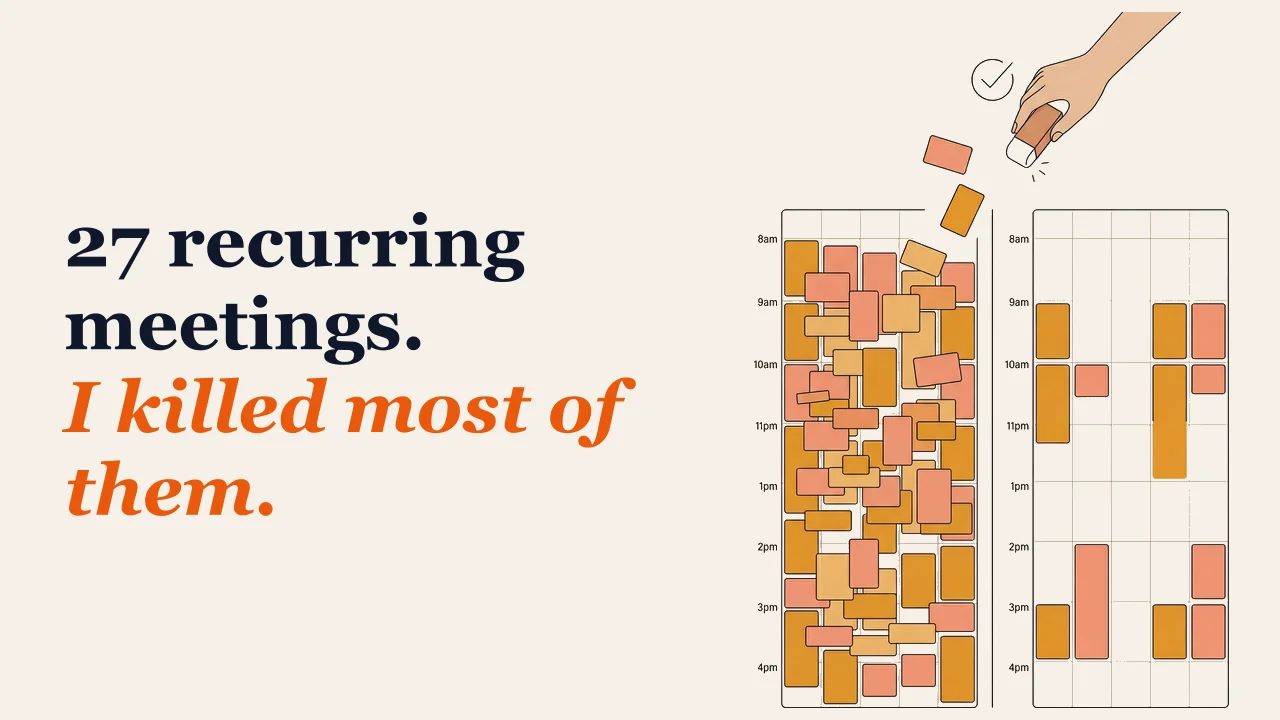
At the peak of my meeting overload, I counted 27 recurring meetings on my calendar.
Twenty-seven.
Leadership team. Department check-ins. Parent committees. Board prep. Staff one-on-ones. Curriculum reviews. Admissions updates. Safety committee. Events planning. And more I’ve blocked from memory.
I was in meetings from 8am to 4pm most days. Then I’d do my actual work from 4pm to 8pm.
This is insane. But it’s also normal. Most school leaders I talk to have similar calendars. We’ve accepted meeting overload as the cost of leadership.
It doesn’t have to be this way.
I did a meeting audit that reclaimed 5+ hours per week. Here’s exactly how.
Step 1: List Every Recurring Meeting
First, I made a complete list of every recurring meeting on my calendar. All of them.
For each meeting, I wrote down:
- Meeting name
- Frequency (weekly, biweekly, monthly)
- Duration
- Attendees
- Stated purpose
This took about 30 minutes. The list was painful to look at.
Step 2: Categorize by Purpose
Next, I categorized each meeting into one of four buckets:
Information sharing — The primary purpose is to share updates. People report on what they’re doing.
Decision making — The primary purpose is to make a decision that requires input from multiple people.
Relationship building — The primary purpose is connection, alignment, or trust-building.
Status quo — “We’ve always had this meeting.” No clear purpose beyond habit.
Be honest with this categorization. Most meetings that feel like “decision making” are actually “information sharing” — and most information can be shared without a meeting.
I wrote more about this distinction in Stop Scheduling Meetings to Decide What to Meet About.
Step 3: Apply the Audit Questions
For each meeting, I asked five questions:
Question 1: What would happen if this meeting didn’t exist?
Really think about it. If you canceled this meeting forever, what would break?
For many meetings, the honest answer is: not much. People would find other ways to communicate. Decisions would still get made. The world would continue.
If nothing would break, the meeting shouldn’t exist.
Question 2: Does this need to be synchronous?
Synchronous time (everyone together at the same time) is expensive. It requires coordination. It takes people away from other work. It fills calendars.
Many meetings can be replaced with:
- A shared document people update asynchronously
- A Slack channel or email thread
- A recorded video update
- A dashboard that shows status
Ask: does this conversation require real-time back-and-forth? Or are we just sharing information that could flow another way?
Question 3: Does this need to be this long?
Most meetings are scheduled in default time blocks: 30 minutes or 60 minutes.
But how much of that time is actually productive? In my experience:
- 60-minute meetings often have 30 minutes of content
- 30-minute meetings often have 15 minutes of content
I started scheduling meetings in unusual increments: 25 minutes, 45 minutes, 50 minutes. The constraint forced focus. Meetings ended on time because the next thing was coming.
Question 4: Do I need to be there?
This one hurt my ego.
I thought I needed to be in every leadership meeting. I was wrong. Many meetings functioned fine — or better — without me there.
Ask: what value do I specifically add to this meeting? If the answer is “oversight” or “just to know what’s happening,” you probably don’t need to be there. Get a summary instead.
Question 5: Does this need to happen this often?
Weekly meetings become weekly by default, not by design.
Some meetings should be weekly. Most shouldn’t.
I converted several weekly meetings to biweekly or monthly. The sky didn’t fall. In fact, those meetings got better because there was more to discuss.
Step 4: Make Decisions
After the audit, I made four types of decisions:
Kill it. Some meetings just got canceled. Gone. I told attendees why and moved on.
Convert it. Some meetings became asynchronous. The weekly ops update became a shared doc. The department check-ins became a Slack channel.
Shrink it. Some meetings got shorter. 60 minutes became 45. 30 became 20.
Reduce frequency. Some meetings went from weekly to biweekly, or biweekly to monthly.
Here’s what the audit yielded:
| Change | Meetings | Time Saved Weekly |
|---|---|---|
| Killed | 4 | 2.5 hours |
| Converted to async | 3 | 2 hours |
| Shortened | 6 | 1.5 hours |
| Reduced frequency | 5 | 1 hour |
| Total | 18 | 7 hours |
Seven hours. Almost a full workday. Reclaimed.
The Meetings I Kept
Not all meetings should be cut. Some are essential:
One-on-ones with direct reports. These are sacred. They’re how you coach, align, and build trust. I never cut these.
Leadership team strategic time. Not status updates — actual strategic discussion. This needs to be synchronous.
Board meetings. Obviously.
High-stakes decision meetings. When a decision is complex and requires real-time debate, a meeting is the right tool.
Relationship meetings. Some meetings exist purely for connection. With key stakeholders, this is time well spent.
The audit isn’t about eliminating meetings. It’s about being intentional.
How to Protect the Time You Reclaim
Reclaiming time only matters if you protect it.
After my audit, I had 7 extra hours on my calendar. If I wasn’t careful, those hours would fill up with new meetings, email, and random requests.
Here’s how I protected the time:
Block it. I created recurring “focus blocks” on my calendar. These show as busy. They’re not available for meetings.
Name it. I labeled these blocks with what they’re for: “Strategic thinking,” “Deep work,” “Writing time.” This reminds me (and others) that it’s not empty time.
Defend it. When someone asks to meet during a focus block, I say: “That time is committed. Can we do [alternative time]?” I don’t explain or apologize.
Use it. Protected time only works if you actually use it for meaningful work. I have a list of strategic projects that only get attention during focus blocks.
I wrote about what this actually looks like in I Got 10 Hours Back This Week.
The Ongoing Discipline
A meeting audit isn’t a one-time thing. Meetings creep back.
Every quarter, I review my recurring meetings:
- Did I add any new ones?
- Are existing ones still serving their purpose?
- Can any be killed, converted, shortened, or reduced?
This takes 30 minutes quarterly. It’s the best 30 minutes I spend on my own productivity.
What About the People?
You might worry: won’t people be upset if I cancel their meetings?
Some might. Here’s how I handle it:
Explain the why. “I’m auditing my meetings to make sure I’m using time well. This meeting is becoming asynchronous because [reason]. You’ll still get the information, just differently.”
Involve them. “I want to make sure this meeting is valuable for you. What would you lose if we canceled it?” Sometimes they’ll tell you nothing. Sometimes they’ll identify value you hadn’t considered.
Offer alternatives. “Instead of this weekly meeting, let’s try a shared doc for updates and a monthly sync for discussion. If that doesn’t work, we can adjust.”
Most people are relieved. They have too many meetings too. They just needed someone to make the first move.
The Bigger Point
Your calendar is a choice. It might not feel like it. But every meeting on your calendar is there because someone decided to put it there — and that someone was often you.
The meeting audit is an exercise in agency. It’s a reminder that you can design your time instead of just accepting it.
Five hours is a lot. That’s a full afternoon. A morning of deep work. Time with your family. Time to think.
You probably won’t get it back by accident. You have to take it.
If you’re drowning in meetings and want help redesigning your operating rhythm, let’s talk. Time reclamation is one of the first things I work on with leaders.
The meeting audit template is included in the No-Admin Second Brain Guide — along with the async alternatives that replace unnecessary meetings.

Want help building systems like this?
We help school leaders automate the chaos and get their time back.