How I Make Claude Answer From Your Own Documents
A generic chatbot guesses. A grounded, guardrailed assistant answers from your materials or admits it can't. Here is the difference, and how I build it.
July 15, 2026
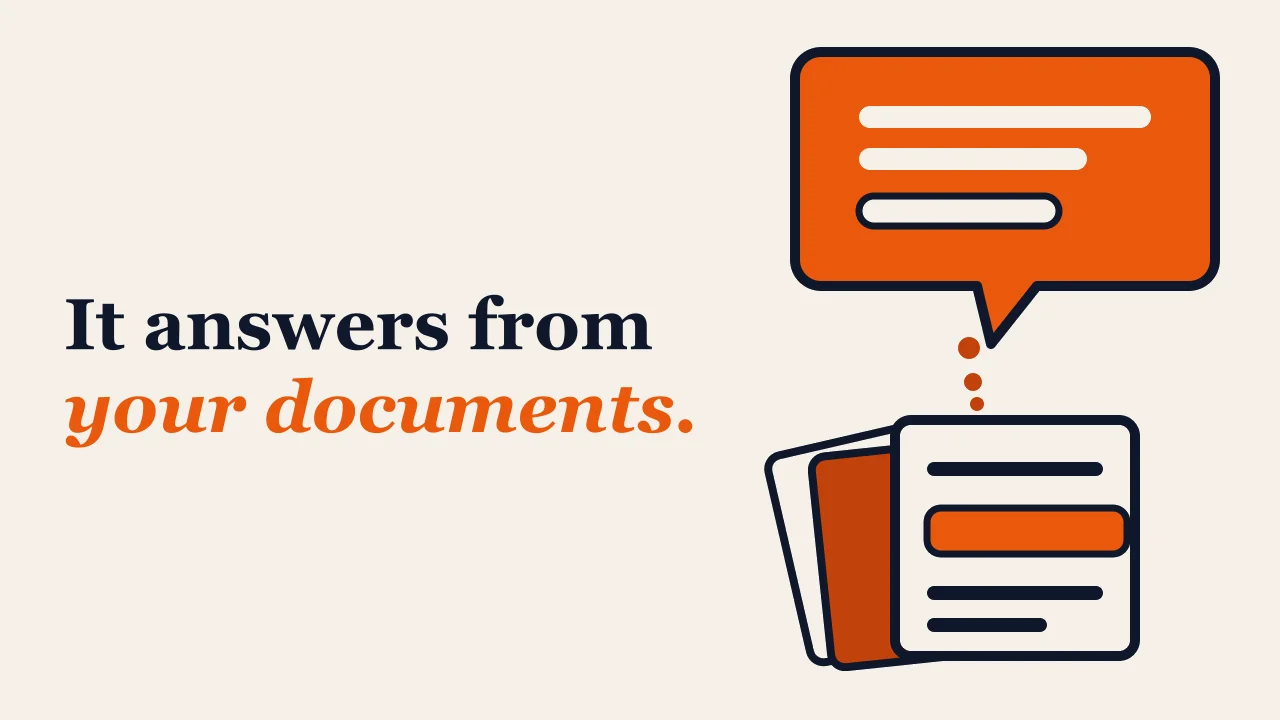
A grounded AI assistant answers from a specific set of documents you give it, and cites where each answer came from, instead of drawing on whatever it absorbed during training. The technique is called retrieval-augmented generation, or RAG. In plain terms: it looks things up in your material before it speaks, rather than guessing from memory.
That one change is the whole difference between a chatbot you can put in front of a customer and one you can’t.
I learned this building a tutor into my own course platform. Students needed to ask questions about the material at 11pm when I was asleep. A generic assistant would happily answer, and it would sometimes answer confidently and wrongly, inventing a rule that sounded right. In a course on financial accounting, a plausible wrong answer is worse than no answer. So I did not want a smarter chatbot. I wanted one that could only speak from the actual course, and would say so when a question fell outside it.
Here is what “grounded and guardrailed” actually means when I build it, and why each part matters for a business.
It reads your documents before it answers
The assistant does not run on what the model happened to learn. Before it responds, it retrieves the relevant passages from the material you gave it, your policies, your product docs, your knowledge base, and answers from those.
Before
Ask a generic chatbot about your refund policy and it invents a reasonable-sounding one. It has never seen yours.
After
Ask a grounded assistant and it quotes your actual policy, with a link to the document it came from.
The whole path, from question to answer, has one extra step in it that changes everything.
For a business, this is the line between a demo and a tool. The demo impresses in a meeting. The tool is the one you trust to answer a real customer without a member of staff reading over its shoulder.
It cites where the answer came from
Every answer points back to the source passage. This is not decoration. It does two jobs. Your team can verify an answer in one click instead of taking the AI’s word for it. And when the assistant is right, the citation is what makes a cautious user believe it.
Key move
The moment a grounded assistant earns trust is not when it gives a good answer. It is the first time someone clicks the citation, sees the answer really was in the handbook, and stops double-checking every reply.
It refuses cleanly when it should
This is the guardrail most builds skip, and the one that matters most. When a question falls outside the material, the assistant says so, plainly, instead of filling the gap with a guess. When a question needs a human, a refund dispute, a compliance judgement, anything with real stakes, it hands off to a person rather than improvising.
Picture the version without it. A student asks the tutor something the course never covers, at midnight, with an exam in the morning. The ungrounded version answers anyway, fluently, and the student revises from an invented rule. Nobody catches it until the paper comes back. The failure is silent, which is exactly what makes it expensive.
So the rule I build in first is simple: say “I could not confirm this” before you guess. An assistant that admits a gap beats one that papers over it, every time.
In practice that rule is a handful of lines, written before anything else and tested harder than any feature:
You answer ONLY from the passages provided below.

- If the passages contain the answer, give it and quote the passage you used.
- If they do not, reply exactly: "I could not confirm this in the course
  materials." Then offer to pass the question to a human.
- Never fill a gap with general knowledge, even when you are confident.
- Anything involving money, deadlines, or a formal decision goes to a human,
  whether or not you found an answer.

Passages:
{retrieved_passages}
The test that matters is not whether it answers well. It is whether it refuses when it should. I feed it questions the documents deliberately do not cover, and if a single one comes back with a fluent invented answer, the build is not finished.
It only knows what it should
The last piece is scope. The assistant sees the documents for the job and no more. A customer-facing helper does not get read access to your HR files. This is set once, in one place, rather than hoped for across a dozen prompts, which is also what makes it safe to connect to the tools you already use.
What this replaces
Put together, a grounded, guardrailed assistant quietly takes over a specific, expensive job: answering the same questions your team answers over and over, from your own information, correctly, at any hour, with a clean handoff when a human is actually needed.
| Generic chatbot | Grounded, guardrailed assistant | |
|---|---|---|
| Where the answer comes from | Whatever the model absorbed in training | The passages retrieved from your own documents |
| Can you check it? | No source to check | Cites the passage, one click to verify |
| When it does not know | Invents something plausible | Says so, and hands off to a person |
| What it can see | Whatever you paste, prompt by prompt | A defined scope, set once, in one place |
| Worst realistic failure | A confident wrong answer nobody catches | An unanswered question that reaches a human |
saved by automating answering repeat questions from staff and customers
That's roughly 260 hours per year back in your life.
That is not a chatbot on your homepage for show. It is a member of the team that only speaks from the manual, cites its sources, and knows when to fetch a person.
The bottom line: the value is not a cleverer model. It is discipline. Read the real documents, cite the source, refuse when unsure, and stay inside a defined scope. Build those four in and you have something a business can actually put in front of its customers. Skip them and you have a confident guesser, which is the last thing you want speaking for you.
Common questions
What is a grounded AI assistant?
A grounded AI assistant answers only from a specific set of documents you give it, and cites the passage each answer came from, instead of drawing on whatever it absorbed during training. The underlying technique is retrieval-augmented generation: it looks the answer up in your material before it speaks.
How is retrieval-augmented generation different from a normal chatbot?
A normal chatbot generates an answer from its training data and cannot tell you where the answer came from. A retrieval-augmented assistant searches your documents first, writes its answer from the passages it found, and links back to them. That makes answers checkable, and it lets the assistant notice when your documents do not cover the question at all.
How do you stop an AI assistant from making things up?
Four controls, built in from the start: retrieve from your documents before answering, cite the source passage, refuse explicitly when the material does not contain the answer, and restrict the assistant to only the documents its job requires. The refusal rule matters most. Test it by asking questions your documents deliberately do not cover.
What does a grounded assistant cost to run?
The build is the cost, not the running. Most of the work goes into document preparation, retrieval setup, and testing the refusal behavior. Once live it answers repeat questions at any hour, which is why it usually replaces a few hours a week of staff time answering the same questions from the same handbook.
Can it connect to the tools we already use?
Yes, and the scope is set in one place rather than hoped for across a dozen prompts. A customer-facing helper gets the product docs and the policies. It does not get read access to HR files. That single boundary is what makes connecting it to your existing systems safe.

Want help building systems like this?
We help school leaders automate the chaos and get their time back.